How a Miami SEO Company Combines Digital Marketing Strategies to Help Businesses Grow Online


Miami's business landscape is highly competitive, with companies across real estate, healthcare, hospitality, retail, construction, and professional services competing for customer attention. Having a website or maintaining social media profiles is no longer enough to establish a strong online presence. Businesses need a coordinated digital marketing strategy that helps them reach potential customers, build credibility, and generate consistent inquiries.
Modern consumers use multiple online channels before choosing a business. They search Google for local services, compare websites, read customer reviews, explore social media profiles, and evaluate different providers. If your business is missing from these digital touchpoints, competitors have more opportunities to attract your potential customers.
This is where a professional SEO company Miami businesses work with can make a difference. By combining search engine optimization, paid advertising, content marketing, social media, and conversion rate optimization, businesses can create a more consistent customer acquisition strategy.
Let's explore how these digital marketing strategies work together to support business growth in Miami.
1. Building a Strong SEO Foundation for Organic Growth
Search engine optimization is an important part of long-term digital marketing. It helps businesses improve their visibility in unpaid search results when potential customers look for relevant products or services.
For example, a person searching for "Miami real estate agency" or "commercial cleaning services in Miami" is already interested in finding a suitable provider. Appearing in relevant search results gives businesses an opportunity to attract these potential customers.
A professional SEO strategy focuses on several areas:
Keyword Research: Identifying search terms based on customer intent, industry relevance, and competition.
On-Page Optimization: Improving title tags, meta descriptions, headings, URLs, and website content.
Technical SEO: Addressing crawlability, indexability, mobile usability, website speed, and technical errors.
Content Optimization: Developing useful service pages and blog articles around relevant customer searches.
Internal Linking: Connecting related website pages to improve navigation and content discovery.
These activities help search engines understand website content and its relevance to specific searches.
However, SEO is not limited to achieving higher keyword rankings. The objective is to attract visitors who are genuinely interested in the products or services a business provides.
2. Using Local SEO to Connect With Nearby Customers
For businesses serving specific geographical areas, local search visibility can directly influence customer acquisition. People frequently search for nearby businesses using phrases such as "dentist near me," "best restaurants in Miami," or "plumber in Coral Gables."
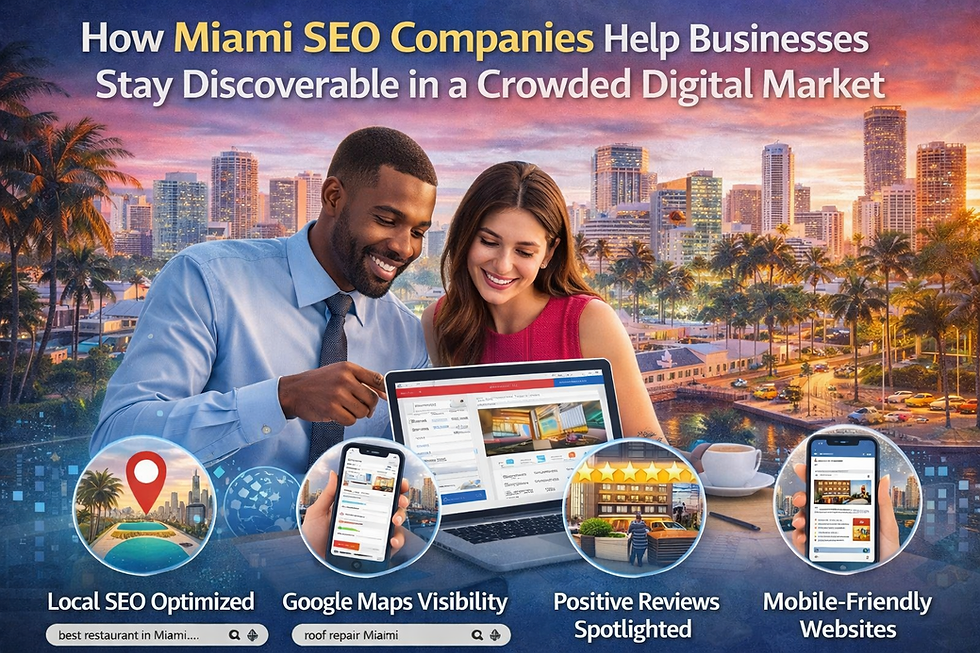
Local SEO helps businesses improve their presence in geographically relevant searches and Google Maps results.
An effective local SEO strategy includes:
Google Business Profile Optimization: Maintaining accurate business details, operating hours, categories, contact information, photographs, and service descriptions.
Location-Based Keyword Research: Identifying relevant searches used by customers in Miami and its surrounding service areas.
Local Business Listings: Maintaining consistent name, address, and phone number information across relevant directories.
Review Management: Encouraging genuine customer feedback and responding professionally to reviews.
Location-Specific Landing Pages: Developing useful pages for the neighborhoods and areas a business actually serves.
For example, a Miami home renovation company serving Brickell, Miami Beach, and Coral Gables can create relevant content addressing the services available in those locations.
Simply adding multiple neighborhood names to website pages will not produce meaningful results. Each location page should provide unique, useful information that reflects the company's actual services and local expertise.
3. Combining Content Marketing With SEO
Content marketing helps businesses reach potential customers at different stages of their buying journey. While SEO identifies the searches a business should target, content marketing provides the information that satisfies those searches.
A coordinated content strategy can include:
Educational blog articles.
Detailed service pages.
Industry-specific guides.
Frequently asked questions.
Product and service comparisons.
Customer success stories.
Local market insights.
Consider a Miami-based real estate company. It can publish articles about neighborhood property trends, home-buying considerations, investment opportunities, and local market conditions.
These resources can attract users researching real estate before they are ready to contact an agent.
Similarly, service pages can target users with stronger purchasing intent, such as people searching for specific services in Miami.
The key is to create content that matches search intent instead of publishing articles simply to increase website volume. Useful content also supports internal linking, topical relevance, and customer trust.
4. Using PPC Advertising to Capture High-Intent Searches
SEO builds organic visibility over time, but businesses may also need a channel that can generate exposure more quickly. Pay-per-click advertising helps address this requirement by placing paid advertisements in front of users searching for relevant products and services.
Google Ads allows businesses to target specific keywords, locations, and customer segments.
For example, a Miami plumbing company can run campaigns targeting emergency plumbing services, drain cleaning, or water heater installation.
A well-managed PPC campaign involves:
Researching high-intent advertising keywords.
Selecting relevant geographical targeting.
Writing clear and relevant ad copy.
Creating dedicated landing pages.
Managing bids and advertising budgets.
Tracking calls, form submissions, and other conversions.
Reviewing search terms and excluding irrelevant traffic.
PPC and SEO serve different purposes, but they can support each other. Organic search can build long-term visibility, while paid campaigns provide additional exposure for competitive or time-sensitive searches.
Search term insights from advertising campaigns can also help identify customer language and potential content opportunities.
5. Strengthening Brand Recognition Through Social Media Marketing
Search engines are not the only places where potential customers discover businesses. Social media platforms provide opportunities to introduce services, demonstrate expertise, and maintain relationships with target audiences.
A coordinated Digital Marketing Miami strategy should consider platforms such as Facebook, Instagram, LinkedIn, and TikTok based on the business's audience and industry.
Social media activities may include:
Educational Posts: Sharing industry tips, useful information, and answers to common customer questions.
Visual Content: Publishing product images, completed projects, service demonstrations, and behind-the-scenes videos.
Customer Testimonials: Showcasing genuine customer experiences to strengthen brand credibility.
Short-Form Videos: Creating reels and videos that explain services, demonstrate expertise, or highlight business activities.
Paid Social Advertising: Promoting relevant content and offers to audiences based on location, interests, and available targeting options.
For instance, a Miami restaurant can use Instagram to showcase its menu, share customer experiences, and promote special events.
Social media engagement does not directly guarantee higher Google rankings. Its value comes from building brand awareness, supporting customer relationships, and creating additional opportunities for people to discover a business.
6. Optimizing Website Experience to Convert Visitors Into Leads
Attracting website visitors is only one part of digital marketing. Businesses also need to convert those visitors into meaningful actions, such as phone calls, quote requests, consultations, and appointments.
A website that loads slowly, provides unclear service information, or makes contact difficult can lose potential customers even when it receives relevant traffic.
Conversion rate optimization (CRO) helps identify and address these problems.
Important website improvements include:
Mobile-Friendly Design: Making sure visitors can navigate the website easily on smartphones and tablets.
Clear Service Information: Explaining what the business offers, who it serves, and which locations it covers.
Visible Calls to Action: Adding relevant buttons such as "Request a Quote," "Book a Consultation," or "Contact Us."
Simplified Forms: Reducing unnecessary form fields to make inquiries easier.
Trust Elements: Displaying authentic reviews, testimonials, certifications, and completed project examples.
Improved Navigation: Organizing website pages so visitors can quickly find relevant information.
A strong website experience connects marketing visibility with customer acquisition. It gives interested visitors a clear path to contact the business.
7. Managing Online Reputation to Build Customer Confidence
Online reputation is an important consideration when customers compare local businesses. Many people read reviews and evaluate customer experiences before deciding which company to contact.
A business with limited reviews, incomplete profiles, or unanswered complaints may struggle to establish credibility.
Reputation management helps companies monitor and maintain their online presence through activities such as:
Encouraging satisfied customers to share genuine feedback.
Monitoring reviews across relevant platforms.
Responding professionally to customer concerns.
Identifying recurring service-related complaints.
Highlighting authentic testimonials on website pages.
Maintaining accurate business information across directories.
For example, a Miami home improvement company can showcase genuine customer reviews and completed projects to help prospective homeowners evaluate its work.
Businesses should avoid fake reviews or misleading incentives. Authentic customer feedback is more valuable for building long-term trust.
8. Using Analytics to Improve Marketing Performance
Digital marketing requires continuous measurement and improvement. Without reliable tracking, businesses cannot accurately determine which channels are generating valuable traffic and which activities are contributing to customer inquiries.
An experienced SEO company Miami businesses partner with should include performance measurement as part of its strategy.
Tools such as Google Analytics 4 (GA4) and Google Search Console help businesses monitor website and search performance.
Important metrics include:
Organic Traffic: Visitors arriving through unpaid search results.
Search Impressions: How frequently website pages appear in search results.
Keyword Rankings: Positions for targeted search queries.
Click-Through Rate: The percentage of impressions that generate clicks.
Conversion Rate: The percentage of visitors who complete desired actions.
Cost Per Lead: The average marketing cost required to generate an inquiry.
Lead Quality: Whether inquiries match the business's target customers.
For example, if a service page receives substantial organic traffic but produces very few inquiries, the problem may involve its content, contact process, calls to action, or overall user experience.
Analyzing these metrics helps businesses identify weaknesses, adjust campaigns, and allocate resources more effectively.
Why Choose a Professional SEO Company in Miami?
Managing SEO, PPC advertising, content marketing, social media, and website optimization requires different technical and creative capabilities. Businesses without an in-house marketing team may struggle to coordinate these activities consistently.
A professional digital marketing partner can bring these channels together under a unified strategy.
Before choosing an agency, evaluate the following:
Strategic Approach: Does the team understand your business objectives, industry, and target audience?
SEO Expertise: Can it explain its technical SEO, local optimization, and content strategy?
Multi-Channel Capabilities: Can it coordinate organic search, paid advertising, social media, and website improvements?
Transparent Reporting: Does it provide measurable performance reports?
Conversion Focus: Does it prioritize qualified leads instead of focusing exclusively on website traffic?
Continuous Optimization: Does it regularly review results and adjust its strategy?
The right agency should provide realistic expectations, clear objectives, and a marketing plan aligned with your business requirements.
Conclusion
Growing a business in Miami requires more than investing in individual marketing channels. Companies need an integrated strategy that connects search visibility, content creation, paid advertising, social media engagement, website performance, and reputation management.
Working with an experienced SEO company Miami businesses can rely on helps bring these activities together and create a stronger foundation for online growth.
At DigitalGuider, we help businesses strengthen their digital presence through SEO, PPC advertising, content marketing, social media management, and website optimization. Our focus is on improving online visibility, attracting relevant audiences, and supporting measurable business growth.
Whether you operate a small local business or an established company, a well-coordinated digital marketing strategy can help you reach more potential customers and compete more effectively in Miami's digital marketplace.
Comments